Tag ssh

Hack The Box: DoubleTake Machine Walkthrough – Easy Difficulity
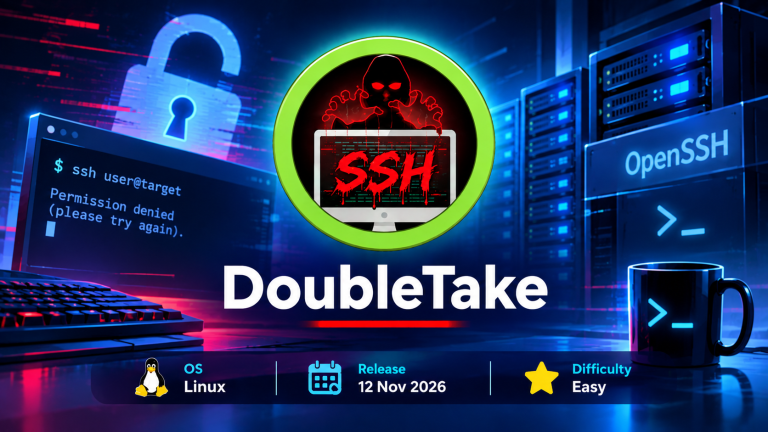
Another Hack The Box Doubletake machine completed!

This machine provided an interesting look at two vulnerabilities and how they can be chained to achieve full system compromise.

The initial foothold involved CVE-2026-123158 (SSHole), an OpenSSH authentication vulnerability that allowed access to an Alpine Linux container. Further investigation uncovered stored Firefox credentials, which provided SSH access as `bob`.

For privilege escalation, I explored CVE-2026-41567, a Docker Engine vulnerability involving malicious decompression executables. By abusing the archive deployment functionality, I achieved a container escape and obtained root access on the host.

Key Takeaways:
- OpenSSH authentication vulnerabilities
- Linux container enumeration
- Firefox credential extraction
- Docker archive extraction abuse
- Container escape and privilege escalation

Another great opportunity to practise Linux enumeration, vulnerability research, and container security.

#HackTheBox #HTB #DoubleTake #CyberSecurity #PenetrationTesting #Linux #Docker #OpenSSH #CVE-2026-123158 #CVE-2026-41567 #PrivilegeEscalation #RedTeam
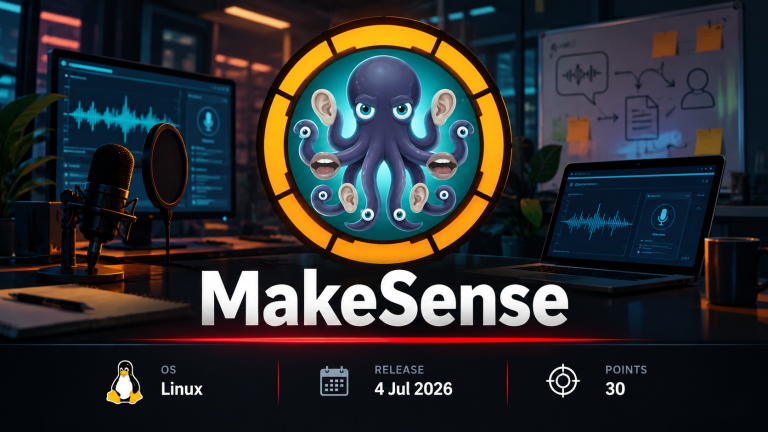
Hack The Box:MakeSense Machine Walkthrough Medium Difficulity

Completed MakeSense (Medium) from Hack The Box, achieving both user and root access.

The initial foothold involved investigating a custom WordPress theme and its voice transcription functionality. Source code analysis revealed a hard-coded encryption key and weaknesses in the application's AJAX implementation. Further investigation led to the recovery of administrator credentials, providing access to the WordPress dashboard. A malicious plugin then enabled remote code execution under the web server account. Additional enumeration uncovered credential reuse in the application configuration, allowing access to the local `walter` account and retrieval of the user flag.

The privilege escalation phase focused on an internally accessible OCR application running on port 8001. Process inspection revealed a root-owned service and script responsible for handling OCR operations. SSH port forwarding provided access to the internal application, where further investigation uncovered a weakness in its processing logic that allowed privileged command execution. The investigation also revealed a SUID-enabled Bash binary, providing an additional path to root access.

MakeSense provided valuable experience in WordPress security, JavaScript source code analysis, application-level vulnerabilities, Linux enumeration, and privilege escalation. It also highlighted how weaknesses in custom application functionality and internal services can lead to complete system compromise.

\#HackTheBox #HTB #MakeSense #WordPress #WebSecurity #LinuxPrivilegeEscalation #PenetrationTesting #OffensiveSecurity #RedTeam #CyberSecurity #EthicalHacking #LearningJourney

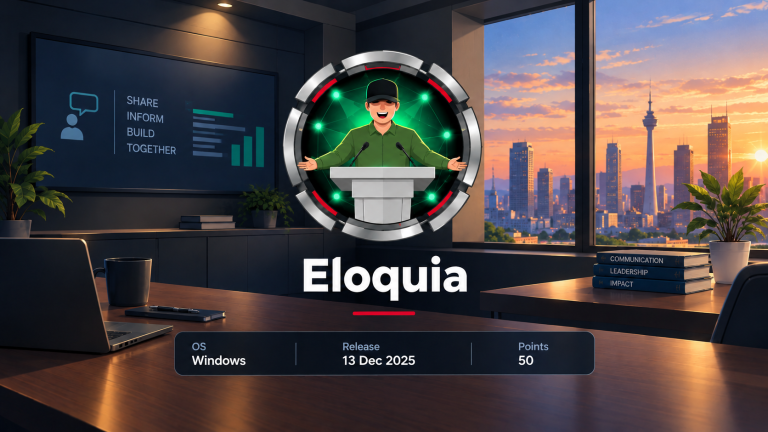
Hack The Box: Eloquia Machine Walkthrough – Insane Difficulty

Just finished the Insane difficulty Eloquia machine on Hack The Box which one of the more layered and creative Windows boxes I’ve done in a while.

The path starts with a custom Django publishing platform that integrates with a Qoogle OAuth service. After registering and creating articles, you discover that the application trusts certain meta-refresh tags and can be leveraged for redirects. Combined with OAuth authorization flows and a bit of CSRF, this opens the door to higher-privilege access inside the web application.

From the admin interface, SQL Explorer becomes available. Because the backend is SQLite, `load_extension` can be abused to load a malicious DLL. That gives the first reverse shell as the `eloquia\web` user and the user flag.

Privilege escalation requires deeper enumeration. Edge browser credentials stored for the Olivia.KAT account can be extracted and decrypted offline. WinRM then provides a stable shell as that user. From there, Seatbelt and process enumeration reveal an interesting custom service called Failure2Ban that runs with high privileges and periodically restarts. By racing a binary overwrite of `Failure2Ban.exe` with a reverse shell, you land as `NT AUTHORITY\SYSTEM` and grab the root flag.

What made this machine feel genuinely Insane was the number of different skill sets required: web application logic, OAuth/CSRF, SQLite extension loading, Windows credential dumping, service abuse under AppLocker and PowerShell restrictions, and careful timing for the final binary overwrite.

Great learning experience overall.

#HackTheBox #CTF #PenetrationTesting #WindowsPrivilegeEscalation #RedTeam #InfoSec #Eloquia #InsaneBox

Hack The Box: Devhub Machine Walkthrough – Medium Difficulty

Completed another Hack The Box machine: Devhub (Medium).

Devhub was a great exercise in exploring modern development tooling, service misconfigurations, and Linux privilege escalation. The journey began with web enumeration and identifying an exposed MCP Inspector service. Further investigation revealed a command injection vulnerability that provided initial access to the machine.

From there, internal service enumeration uncovered a localhost-only Jupyter instance. Accessing it through SSH port forwarding and investigating its authentication mechanism opened the path to another user. The final stage involved examining an internal operations service, understanding its exposed functionality, and identifying a weakness that ultimately led to root access.

Devhub highlights how development tools, internal services, and poorly secured administrative functionality can create unexpected attack paths when combined. Another valuable machine for practising enumeration, lateral movement between local users, and privilege escalation.

#HackTheBox #HTB #CyberSecurity #PenetrationTesting #RedTeam #OffensiveSecurity #Linux #PrivilegeEscalation #WebSecurity #MCP #InfoSec

Hack The Box: Reactor Machine Walkthrough – Easy Difficulty

Completed another Hack The Box machine: Reactor, an Easy-difficulty Linux challenge.

The initial foothold came from enumerating the Next.js application running on port 3000. Version fingerprinting identified a vulnerable React canary release associated with CVE-2025-55182 (React2Shell). Further testing confirmed remote code execution through the React Server Components functionality, providing access as the node user.

From the application environment, the SQLite database exposed credentials for the engineer account. After recovering the password from the stored MD5 hash, SSH access provided the user-level foothold.

For privilege escalation, process enumeration revealed a root-owned Node.js service with the inspector exposed on localhost. The Node inspector provided a path to execute code within the root process and modify /bin/bash permissions, ultimately leading to a root shell.

I also explored an alternative approach using SSH local port forwarding and Chrome DevTools to access the remote Node inspector.

Another useful HTB machine for practicing web enumeration, version fingerprinting, application-layer exploitation, Linux enumeration, and Node.js debugging interfaces.

#HackTheBox #HTB #CyberSecurity #PenetrationTesting #RedTeam #OffensiveSecurity #WebSecurity #Linux #NextJS #React #NodeJS #CVE #PrivilegeEscalation #CTF #CyberSecurityLearning

Hack The Box: Silentium Machine Walkthrough – Easy Difficulity

Completed another Hack The Box machine, Silentium.

Initial access was achieved by exploiting a password-reset vulnerability in the staging Flowise application, followed by abusing a custom MCP endpoint to obtain a root shell inside the Flowise container. Credentials exposed through the container environment were then used to SSH into the underlying host as ben and retrieve the flag.

For privilege escalation, an internal Gogs instance was discovered through local port forwarding. A malicious symlink was pushed and manipulated through the Gogs API to target /etc/sudoers.d/ben, allowing a passwordless sudo rule to be written and ultimately providing full root access.

#HackTheBox #HTB #CyberSecurity #PenetrationTesting #OffensiveSecurity #Linux #PrivilegeEscalation #WebSecurity #CTF

HackTheBox: CobbleStone Machine Walkthrough – Insane Difficulty

Completed the Hack The Box “CobbleStone” Insane machine, chaining multiple vulnerabilities to achieve full system compromise.

Initial access was achieved through SSRF in the skin suggestion feature, followed by SQL injection and stored XSS to compromise the administrator’s session. The stolen session cookie provided admin access, leading to Twig SSTI and RCE as www-data. Database credentials recovered through SSTI enabled a database dump and password cracking, resulting in SSH access as cobble and the user flag.

Local enumeration revealed Cobbler’s XML-RPC service on port 25151. After identifying Cobbler 3.3.6 as vulnerable to CVE-2024-47533, a malicious Cheetah template was used to execute commands with root privileges. This provided a root shell and access to /root/root.txt.

#HackTheBox #HTB #CobbleStone #CyberSecurity #PenetrationTesting #OffensiveSecurity #WebSecurity #SSRF #SQLInjection #XSS #SSTI #PrivilegeEscalation #CVE-2024-47533

Hack The Box: Kobold Machine Walkthrough – Easy Difficulty

Completed the Hack The Box "Kobold" machine, an easy-difficulty Linux challenge focused on web exploitation and container-based privilege escalation.

The assessment involved identifying and exploiting an unauthenticated Remote Code Execution vulnerability (CVE-2026-23744) in MCPJam Inspector to gain initial access as the ben user. During the privilege escalation phase, I explored Docker security weaknesses by leveraging excessive group permissions to escape the container environment and obtain root access. Additionally, I analyzed an alternative attack path involving CVE-2025-64714 in PrivateBin, which allowed sensitive configuration data exposure and access to the Arcane container management interface. This machine provided practical experience in vulnerability exploitation, container security assessment, and identifying risks associated with exposed internal services.

#HackTheBox #HTB #CyberSecurity #PenetrationTesting #OffensiveSecurity #RedTeam #Linux #Docker #VulnerabilityManagement #CVE #EthicalHacking #CybersecurityLearning

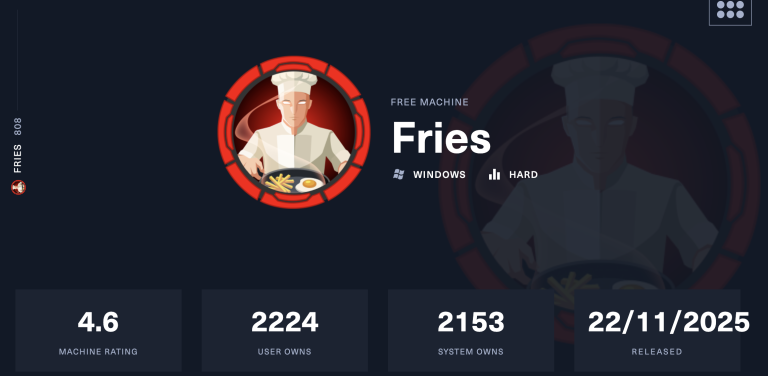
Hack The Box: Fries Machine Walkthrough – Hard Difficulty

Just wrapped up another Hack The Box machine: Fries (Hard).

TThis machine provided a realistic attack path that started with source code review in Gitea, where leaked credentials in a Git commit led to authenticated PostgreSQL RCE through pgAdmin. From there, I pivoted through the internal Docker network using Ligolo-ng, abused an exposed NFS share and debugfs to gain host access, then exploited PWM configuration weaknesses to capture LDAP credentials. The final stage involved Active Directory enumeration and AD CS (ESC6/ESC7) abuse to obtain an administrator certificate and compromise the domain. A great lab for practising web exploitation, Docker security, Linux privilege escalation, internal pivoting, and Active Directory attacks.

#HackTheBox #HTB #CyberSecurity #PenetrationTesting #RedTeam #ActiveDirectory #ADCS #Docker #Ligolo #PostgreSQL #Gitea #EthicalHacking #Writeup #CTF

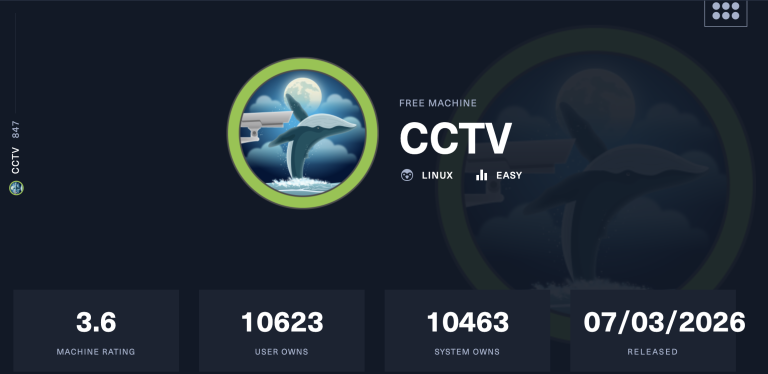
Hack The Box: CCTV machine walkthrough – Easy Difficulty

Just completed the CCTV machine from Hack The Box!

After enumerating the target, I discovered a ZoneMinder instance exposed on the web interface. Using the default administrative credentials, I gained access to the application and identified a SQL injection vulnerability in the removetag endpoint. By leveraging SQLMap, I extracted the database contents and recovered valid credentials through bcrypt hash cracking with Hashcat, allowing SSH access as the mark user and securing the User flag.

For privilege escalation, I discovered a locally running MotionEye service and extracted authentication details from its configuration files. After accessing the internal web interface through SSH port forwarding, I exploited a command injection vulnerability in the image filename configuration to obtain a root shell and capture the Root flag.

Really enjoyed this Easy-difficulty box — a great combination of web application exploitation, SQL injection, credential recovery, and Linux privilege escalation techniques!

#HackTheBox #HTB #PenetrationTesting #CyberSecurity #PrivilegeEscalation #SQLInjection #EthicalHacking #Linux #OffensiveSecurity