Tag MySQL

HackTheBox: CobbleStone Machine Walkthrough – Insane Difficulty
Completed the Hack The Box “CobbleStone” Insane machine, chaining multiple vulnerabilities to achieve full system compromise.

Initial access was achieved through SSRF in the skin suggestion feature, followed by SQL injection and stored XSS to compromise the administrator’s session. The stolen session cookie provided admin access, leading to Twig SSTI and RCE as www-data. Database credentials recovered through SSTI enabled a database dump and password cracking, resulting in SSH access as cobble and the user flag.

Local enumeration revealed Cobbler’s XML-RPC service on port 25151. After identifying Cobbler 3.3.6 as vulnerable to CVE-2024-47533, a malicious Cheetah template was used to execute commands with root privileges. This provided a root shell and access to /root/root.txt.

#HackTheBox #HTB #CobbleStone #CyberSecurity #PenetrationTesting #OffensiveSecurity #WebSecurity #SSRF #SQLInjection #XSS #SSTI #PrivilegeEscalation #CVE-2024-47533
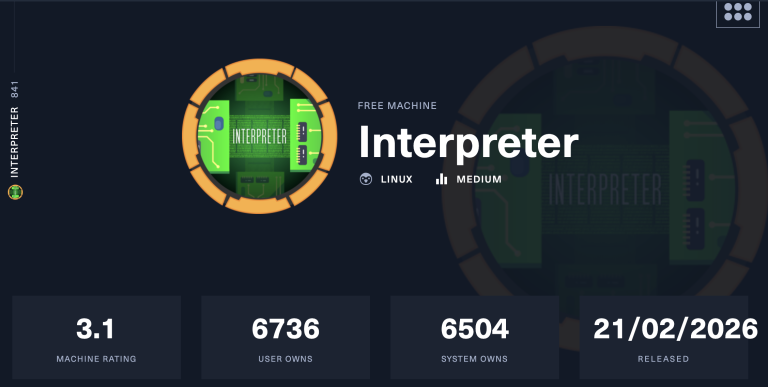
Hack The Box:Interpreter Machine Walkthrough – Medium Difficulty

Completed Hack The Box machine “Interpreter” after exploiting CVE-2023-43208 in NextGen Healthcare Mirth Connect 4.4.0. Initial access involved API enumeration, unsafe Java deserialization exploitation, reverse shell execution, and database credential extraction from Mirth Connect configuration files. Cracking the recovered PBKDF2-HMAC-SHA256 hash provided SSH access as sedric and access to the user flag.

Privilege escalation involved enumerating a root-owned Flask notification service vulnerable to Server-Side Template Injection (SSTI). By forwarding the internal service over SSH and crafting a malicious XML payload, remote command execution as root was achieved, leading to retrieval of the root flag.

#HackTheBox #HTB #CyberSecurity #RedTeam #EthicalHacking #PenetrationTesting #OffensiveSecurity #WebSecurity #PrivilegeEscalation #SSTI #Deserialization #Linux #InfoSec #CVE202343208

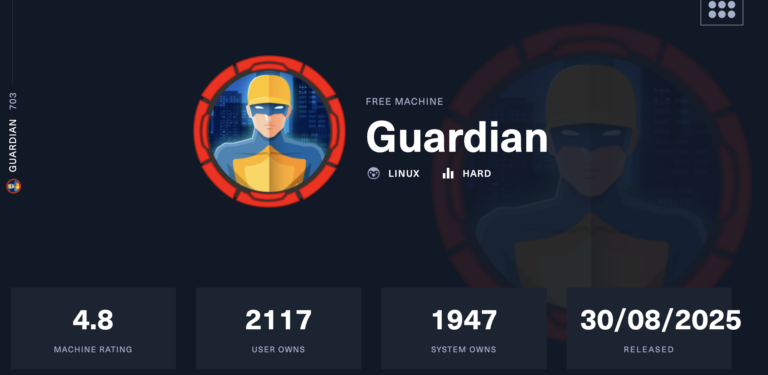
Hack The Box: Guardian Machine Walkthrough – Hard Difficulty

🔐 User Flag — Compromising the Application Layer

Successfully rooted the Guardian (Hard) machine on Hack The Box by chaining multiple real-world web vulnerabilities.Initial access was achieved through credential abuse and IDOR within the student portal. Leaked chat credentials exposed internal Gitea repositories containing hardcoded database secrets. A vulnerable XLSX file upload feature allowed formula injection → XSS → session hijacking. Leveraging CSRF, I created a rogue admin account and escalated privileges within the application. From there, an LFI vulnerability combined with a PHP filter chain led to Remote Code Execution. After gaining a shell as www-data, I reused leaked credentials to pivot laterally to user jamil, capturing the user flag.

👑 Root Flag — From Code Injection to Full System Compromise

Privilege escalation started with sudo -l, revealing that jamil could execute a Python utility as user mark without a password. Since one of the Python files was writable, I injected code to spawn a shell as mark. Further enumeration uncovered a custom binary (safeapache2ctl) executable as root. A flawed validation mechanism in its Apache config parsing allowed path traversal and arbitrary file inclusion. By crafting a malicious shared object (evil.so) and abusing the wrapper’s improper include validation, I achieved root-level code execution and obtained a root shell.

Hack The Box: Outbound Machine Walkthrough – Easy Difficulity

Successfully completed the Outbound HTB machine. Initial access was gained by exploiting CVE‑2025‑49113 in Roundcube 1.6.10 using Tyler’s credentials, which allowed remote code execution.

Investigation of Roundcube’s configuration revealed database credentials, enabling decryption of Jacob’s session data and retrieval of his plaintext password. Using this, SSH access was obtained to capture the user flag.

Privilege escalation was achieved via CVE‑2025‑27591 by exploiting a world-writable /var/log/below directory, allowing command execution as root and retrieval of the root flag. This walkthrough highlights the importance of secure configuration, patching, and proper permission management.

#HackTheBox #CyberSecurity #PenTesting #EthicalHacking #VulnerabilityExploitation #Roundcube #PrivilegeEscalation #LinuxSecurity #CVE2025

Hack The Box: Certificate Machine Walkthrough – Hard Difficulty

I recently completed the "Certificate" challenge on Hack The Box: after extracting and cracking a captured authentication hash I gained access to a user account (lion.sk) and retrieved the user flag, then progressed to full system compromise by responsibly exploiting weak certificate‑based authentication controls—obtaining and converting certificate material into elevated credentials to capture the root flag. The exercise reinforced how misconfigurations in certificate services and poor time synchronization can create powerful escalation paths, and highlighted the importance of least‑privilege, strict enrollment policies, and monitoring certificate issuance. Great hands‑on reminder that defensive hygiene around PKI and identity services matters.

#CyberSecurity #HTB #Infosec #ADCS #Certificates #PrivilegeEscalation #RedTeam #Pentesting

HackTheBox – BigBang Machine Walkthrough (Hard Difficulty)

Chained exploitation through misconfigured web app and internal services. We started by exploiting a WordPress plugin vulnerability (CVE-2023-26326) to upload files, followed by a file read vulnerability (CVE-2024-2961) for remote code execution. From there, we cracked the database credentials, gained SSH access as the shawking user, and leveraged a vulnerable API endpoint to escalate to root. This highlights how overlooked configurations and service misconfigurations can lead to a full server compromise.

#CTF #PrivilegeEscalation #WebSecurity #CommandInjection #SSH #WordPress #LinuxPentesting #BugBounty #HackTheBox #RedTeam #CyberSecurity