Tag Linux

Hack The Box: Sorcery Machine Walkthrough – Insane Difficulty
Recently, I completed the “Sorcery” machine on Hack The Box (Insane difficulty), which provided a deep, multi-layered challenge combining modern web exploitation, internal pivoting, and complex privilege escalation.

The attack began with reconnaissance of a self-hosted Gitea instance, where exposed source code revealed the application architecture. This led to identifying a Cypher injection vulnerability in functionality backed by Neo4j, which enabled SSRF to leak sensitive data such as password hashes and a registration key. After gaining seller access, a stored XSS payload was used to hijack an admin session and access a restricted debug feature. This interface allowed interaction with internal services, ultimately achieving remote code execution via a Kafka-based payload. From there, pivoting with Ligolo-ng exposed internal services, including an FTP server containing an encrypted private key, which was cracked offline to gain SSH access and retrieve the user flag.

Privilege escalation required chaining multiple subtle misconfigurations. A running Xvfb instance exposed a screen dump containing credentials for a higher-privileged user. With limited sudo access, strace was used to capture plaintext credentials from running processes. Further enumeration revealed activity tied to FreeIPA, where identity management controls were abused to gain full sudo privileges. After applying the changes, this ultimately led to root access and full system compromise.

#HackTheBox #CyberSecurity #PenetrationTesting #RedTeam #EthicalHacking #CTF #Infosec #PrivilegeEscalation #WebSecurity
Hack The Box: Airtouch Mahcine Walkthrough – Medium Diffiiculty

Recently, I completed the “Airtouch” machine on Hack The Box (Medium difficulty), which provided a great hands-on experience in combining system exploitation with wireless attack techniques.

The challenge started with basic reconnaissance and service enumeration, leading to initial access via SSH as a low-privileged user. From there, misconfigured sudo permissions allowed quick privilege escalation on the host. What made this machine particularly interesting was its setup as a wireless attack platform, requiring interaction with a simulated corporate Wi-Fi environment.

By cracking a WPA2-PSK handshake and connecting to the internal network, I was able to pivot further, access an internal access point, and exploit an unrestricted file upload vulnerability to gain remote shell access. Additional enumeration revealed credentials that enabled lateral movement to a management server, ultimately leading to full root compromise.

Overall, this machine was a great reminder of how misconfigurations, weak credentials, and insecure file handling can chain together into a full system compromise—especially in complex environments involving internal networks and wireless infrastructure.

#HackTheBox #CyberSecurity #PenetrationTesting #RedTeam #EthicalHacking #CTF #Infosec #PrivilegeEscalation #NetworkSecurity

Hack The Box: Browsed Machine Walkthrough – Medium Diffucility

Completed the Browsed machine on Hack The Box 🚀

Gained initial access by uploading a malicious Chrome extension with a reverse shell payload. Automated testing executed it, giving a foothold as larry and access to user flag.

Escalated privileges by abusing a misconfigured sudo rule on extension_tool.py. A world-writable pycache directory allowed bytecode poisoning, leading to root access and full compromise.

Great box for practicing client-side attacks, extension abuse, and privilege escalation via Python internals.

#HackTheBox #CyberSecurity #EthicalHacking #PenetrationTesting #RedTeam #PrivilegeEscalation #WebSecurity #CTF
Hack The Box: Conversor Machine Walkhtrough – Easy Difficulity

Successfully completed the Conversor machine on Hack The Box, focusing on web exploitation and privilege escalation techniques.

For the user flag, initial access was gained by exploiting an insecure XSLT file upload feature. By leveraging EXSLT, I was able to write and execute a malicious script on the server, resulting in a reverse shell as a low-privileged user. Further enumeration uncovered a SQLite database containing hashed credentials, which were cracked to obtain valid SSH access and retrieve the user flag.

For the root flag, privilege escalation was achieved through a misconfigured sudo permission allowing execution of needrestart. This was abused to run a crafted script that modified system binaries, ultimately granting root-level access via a SUID bash shell and completing the machine.

#HackTheBox #CyberSecurity #EthicalHacking #PenetrationTesting #WebSecurity #PrivilegeEscalation #RedTeam #InfoSec #CaptureTheFlag #CTF

Hack The Box: Gavel Machine Walkthrough – Medium Difficulity

Completed the Gavel (Medium) machine on Hack The Box. The initial foothold came from an exposed .git directory that leaked the application’s source code and bcrypt password hashes. After cracking the credentials with John the Ripper, I gained access and achieved a reverse shell through command injection in the admin rule field. Reusing the cracked credentials allowed privilege escalation to the application user and retrieval of the user flag.

Root access was obtained by abusing the gavel-util submission feature, which executed YAML rule fields using PHP system(). By overwriting the custom php.ini to remove restrictions and creating a SUID Bash binary, it was possible to spawn a root shell and capture the final flag.

#HackTheBox #HTB #CyberSecurity #EthicalHacking #PenetrationTesting #RedTeam #LinuxSecurity #WebSecurity #PrivilegeEscalation #CTF

Hack The Box: Expressway Machine – Easy Difficulity

Just completed Expressway on Hack The Box (Easy difficulty) – a solid box that blends weak IKE PSK cracking with a straightforward sudo privilege escalation!
Enumeration started with UDP scanning, which revealed ISAKMP on port 500. I ran ike-scan in Aggressive Mode to leak the peer identity ike@expressway.htb and capture crackable parameters. Next I used psk-crack against rockyou.txt and recovered the PSK freakingrockstarontheroad in under 13 seconds. I logged in via SSH as ike using that password and quickly grabbed user.txt.

For privilege escalation, sudo -l confirmed no rights for the ike user. Checking sudo -V showed version 1.9.17 vulnerable to CVE-2025-32463 (chwoot). I cloned the PoC repository on my attack machine, hosted sudo-chwoot.sh with a Python HTTP server, transferred it to the target using curl, made it executable, and ran it. The script printed “woot!” and dropped an instant root shell. From there I read root.txt.
Nice and clean chain: weak PSK for initial access followed by a known sudo vulnerability for root. Perfect easy box to sharpen IKE enumeration and Linux local exploitation skills.

#HackTheBox #CTF #PenetrationTesting #Cybersecurity #EthicalHacking #IKE #PSKCracking #PrivilegeEscalation #LinuxExploitation #CVE202532463 #RedTeam

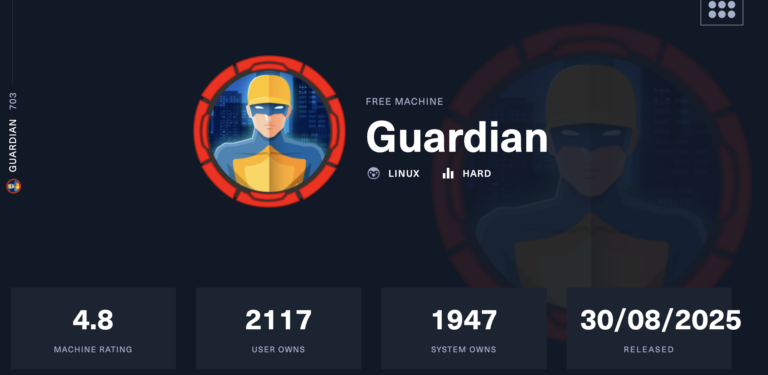
Hack The Box: Guardian Machine Walkthrough – Hard Difficulty

🔐 User Flag — Compromising the Application Layer

Successfully rooted the Guardian (Hard) machine on Hack The Box by chaining multiple real-world web vulnerabilities.Initial access was achieved through credential abuse and IDOR within the student portal. Leaked chat credentials exposed internal Gitea repositories containing hardcoded database secrets. A vulnerable XLSX file upload feature allowed formula injection → XSS → session hijacking. Leveraging CSRF, I created a rogue admin account and escalated privileges within the application. From there, an LFI vulnerability combined with a PHP filter chain led to Remote Code Execution. After gaining a shell as www-data, I reused leaked credentials to pivot laterally to user jamil, capturing the user flag.

👑 Root Flag — From Code Injection to Full System Compromise

Privilege escalation started with sudo -l, revealing that jamil could execute a Python utility as user mark without a password. Since one of the Python files was writable, I injected code to spawn a shell as mark. Further enumeration uncovered a custom binary (safeapache2ctl) executable as root. A flawed validation mechanism in its Apache config parsing allowed path traversal and arbitrary file inclusion. By crafting a malicious shared object (evil.so) and abusing the wrapper’s improper include validation, I achieved root-level code execution and obtained a root shell.

Hack The Box: GiveBack machine walkthrough – Medium Difficulity

Just completed the Giveback machine on Hack The Box (Medium difficulty).
Started with Nmap → WordPress + vulnerable GiveWP 3.14.0 (CVE-2024-5932 / CVE-2024-8353 PHP Object Injection) → unauthenticated RCE via donation form PoC → reverse shell as bitnami in a Bitnami Kubernetes pod.
Pivoted using mounted K8s service account token → abused the API + exploited a vulnerable legacy PHP-CGI intranet service → broke out to the host as user babywyrm → grabbed user.txt.

For root: passwordless sudo on custom /opt/debug binary → used dumped secret as admin password → crafted malicious OCI config.json → ran privileged container via runc breakout → read root.txt.
Great chain: web vuln → container escape → K8s lateral → sudo abuse.
Loved the real-world Kubernetes misconfig + runc wrapper elements.

#HackTheBox #CTF #PenetrationTesting #KubernetesSecurity #ContainerEscape #RCE #PrivilegeEscalation #Cybersecurity

Hack The Box: Soulmate machine walkthrough – Easy Difficulitty

Just completed the Soulmate machine on Hack The Box — rated Easy, but packed with a satisfying vuln chain!
Started with subdomain enumeration → discovered an exposed CrushFTP admin panel on ftp.soulmate.htb. Exploited an unauthenticated API flaw (CVE-2025-31161 style) in the /WebInterface/function/ endpoint to enumerate users and create a backdoor admin account. From there, abused broken access controls in User Manager to reset the "ben" account password. Logged in as "ben" → gained VFS access to /webProd (the main web root), uploaded a PHP webshell → got RCE as www-data with a reverse shell.
Credential reuse let me su ben and grab user.txt

Root came via a backdoored Erlang SSH daemon on localhost:2222 (hardcoded always-true auth, running as root) → trivial escalation to root Eshell and root.txt

Key takeaways: exposed admin panels are goldmines, weak API auth leads to quick takeovers, credential reuse is still everywhere, and custom services with backdoors can hand you root on a platter.
Loved the progression from web misconfig → file write → RCE → local privesc. Solid learning box!

#HackTheBox #HTB #CyberSecurity #PenetrationTesting #CTF #PrivilegeEscalation #RCE #BugBounty #RedTeam

Hack The Box: CodePartTwo Machine Walkthrough – Easy Diffculty

Just finished CodePartTwo on Hack The Box — a fun Easy-rated Linux box that taught me a lot!

Initial access came via a js2py sandbox escape in their online JavaScript code editor (CVE-2024-28397 style prototype chain abuse) → reverse shell as 'app'.
Post-exploitation: found users.db in /app/instance → quick Python HTTP server exfil → local sqlite3 dump → two MD5 hashes. CrackStation instantly revealed marco's password (sweetangelbabylove).
Lateral move: SSH as marco → user.txt claimed.

Privesc: sudo -l gave NOPASSWD /usr/local/bin/npbackup-cli. After inspecting npbackup.conf (stdin_from_command hint), I used --external-backend-binary to point to my malicious reverse shell script → root shell → root.txt captured.

Loved how it combined modern sandbox escape with classic sudo misconfig abuse. Solid box for anyone practicing foothold → lateral → root paths.

#HackTheBox #CTF #PenetrationTesting #Cybersecurity #PrivilegeEscalation #SandboxEscape #LinuxPrivilegeEscalation #RedTeamOps #BugBountyHunter #EthicalHacking